Piano Keys Notes
Find any piano note, hear its sound, and learn the keyboard pattern.
The white keys repeat A, B, C, D, E, F and G. The black keys form groups of two and three. Start with middle C, or enter a note to find its key.
C4
Middle C
A starting point on the keyboard.
C3–C5
Choose by note name
10-note round · Your pace
Find your way around the keys.
Natural notes · C4–C5 · Without labels
Natural notes · C4–C5 · Without labels
How this practice works
- See your resultFirst tries, helped answers, and revealed notes stay distinct.
- Review missed notesPractice only the notes that need another look.
- Share the practiceInvite someone to start a fresh round without sharing your answers.
Piano keys notes chart
Use this one-octave chart to learn the repeating pattern. C sits just before a group of two black keys. F sits just before a group of three.
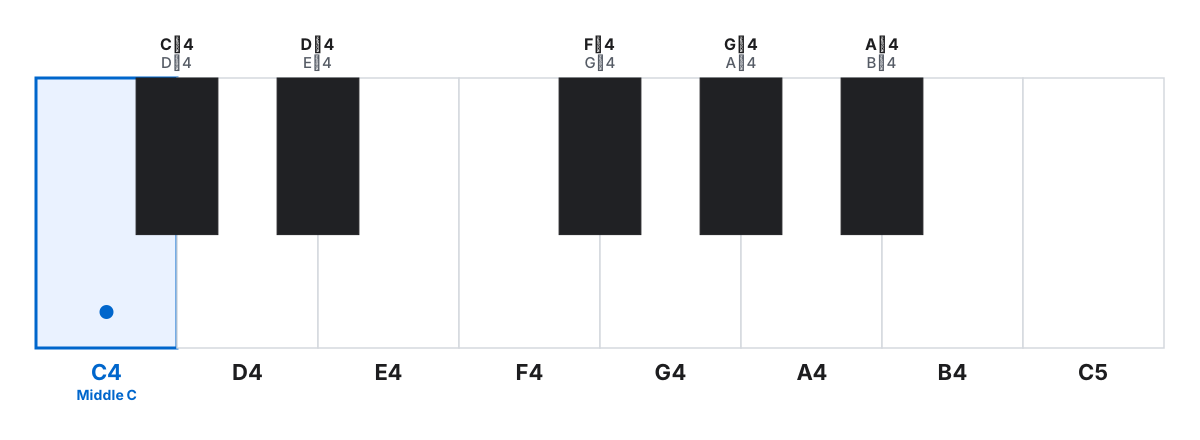
Black-key names in this octave:
- C♯4/D♭4
- D♯4/E♭4
- F♯4/G♭4
- G♯4/A♭4
- A♯4/B♭4
View printable labelsBlank piano keyboard worksheetMatch notes to the staffC4–C5 piano key-name pack (A4, 3-page PDF)
Practice naming the keys with a printable blank keyboard.
How to read piano key names
White keys: seven letters, repeated
The white keys use the letters A through G. Starting on C, the sequence is C, D, E, F, G, A, B, then C again. The octave number tells you which version of a note to play.
Black keys: sharps and flats
A black key usually has two familiar names. The key between C and D is C-sharp (C♯) or D-flat (D♭). The five pairs are C♯/D♭, D♯/E♭, F♯/G♭, G♯/A♭ and A♯/B♭. There is no black key between E and F or between B and C. Sharps and flats can also name white keys.
Find middle C
This guide calls middle C C4. Find the C immediately to the left of a two-black-key group near the middle of your keyboard. Select C4 above to see and hear it.
88-key and 61-key keyboards
A standard 88-key piano runs from A0 to C8, with 52 white keys and 36 black keys. A common 61-key layout runs from C2 to C7, spanning five octaves. Check the endpoints of your own instrument; not every keyboard uses the same range.
Questions about piano keys notes
What are the notes on piano keys?
White keys repeat A, B, C, D, E, F and G. Black keys are commonly named with sharps or flats.
Why are there several C keys?
The note names repeat in each octave. C3, C4 and C5 are different pitches with the same letter name.
Is C♯ the same piano key as D♭?
Yes. On a piano, C♯ and D♭ name the same key. The spelling depends on the musical context.
Where can I get printable labels?
Open our labeled keyboard reference for printable learning resources.