Piano Keyboard Layout: Black and White Keys
Piano keys become easier to recognize when you stop seeing one long row and start noticing the small pattern inside it. Begin with a group of two black keys, then look for the group of three beside it. These groups are your landmarks, even when there are no labels.
Find the Groups of Two and Three Black Keys
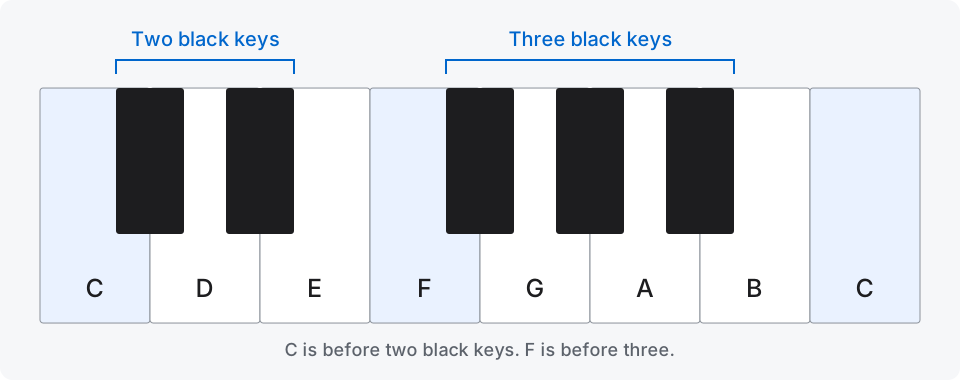
Look at the two black piano keys together. The white key immediately to their left is C, the one between them is D, and the one just to their right is E. In the next group, the white key just before three black keys is F. The remaining white keys in that group are G, A and B.
Try pointing to these locations before reading their names. Find the pair of black keys, touch the white key between them, and say D. Then find a group of three and locate F at its left edge. Use the shape of the piano keys as your clue instead of counting from the far end.
See How the Pattern Repeats
Move to the next group of two black keys. The piano keys named C, D and E appear again, but the notes sound higher as you move right. The repeating piano keys let you transfer what you learned in one small area to the rest of the instrument.
There is no black key between E and F or between B and C. Those gaps are part of the pattern, not missing notes. Notice both gaps as you explore the piano keys. On the diagram, follow C through B once, then find the next C to begin the pattern again.
What Are the Piano Keys Called?
Piano keys are usually identified by the notes they play. The familiar letter names are A, B, C, D, E, F and G. A sharp or flat changes a note name; an octave number identifies which occurrence of that note you mean.
White Key Names: A Through G
Starting at C and moving right on the white piano keys, say C, D, E, F, G, A, B, then C again. The musical alphabet returns to A after G. You do not need a different set of letters for the next part of the keyboard.
Practice naming piano keys in both directions. From C, move right to D and E, then return through D to C. From F, move right to G and A. A useful next step is to point to a note before saying its name, rather than reciting all the letters every time.
Black Key Names: Sharps and Flats
The black key between C and D is commonly called C-sharp or D-flat. On piano keys, a sharp moves a note up one half step; a flat moves it down one half step. On a piano, one half step means moving to the adjacent key, whether that key is white or black.
The five familiar pairs of names for black piano keys are C♯/D♭, D♯/E♭, F♯/G♭, G♯/A♭ and A♯/B♭. The spelling used in music depends on context. Do not assume that a sharp or flat always means a black key: E♯, for example, uses the same piano key as F.
Know the note you need? Find piano keys notes and hear the result.
Find Middle C and Understand Octaves
Middle C is a useful reference when learning piano keys. PianoGrid calls it C4. The letter tells you the note name, while the number distinguishes it from other C notes on the instrument.
Which C Is Middle C?
First identify C using a pair of black piano keys. Then check its octave label. Several piano keys are named C, so the shape alone tells you the letter, not whether you have found middle C. Select Show middle C in the explorer to return to C4.
When locating piano keys, remember that middle C is a particular pitch, not necessarily the key at the exact geometric center of every instrument. Some keyboards and music programs use different octave-number conventions. Compare the actual pitch and the instrument documentation when labels disagree instead of assuming that the notes themselves have changed.
Why the Same Note Names Repeat
The piano keys C4 and C5 play different pitches with the same letter name. Moving from C4 to C5 takes you up one octave: twelve half steps. In the naming convention used here, the octave number changes at C, so B4 is followed by C5.
Try hearing C4, then C5. Next, find D in each of those octaves. The positions within the black-key pattern stay the same while the pitches change. Separate these two questions as you learn piano keys: which note name is this, and which octave am I in?
How Many Piano Keys Are There?
A standard modern piano has 88 keys, but electronic keyboards come in several sizes. The number changes how far the instrument reaches into low and high notes. It does not change the repeating pattern you use to identify piano keys.
The 88-Key Piano Layout
The standard set of 88 piano keys runs from A0 to C8 and contains 52 white keys and 36 black keys. Its left edge begins partway through the familiar pattern, so the first key is A rather than C. Extended-range and historical instruments can have different layouts.
Use the 88-key option in the explorer to choose that overall range. The interactive area shows a readable window, not all 88 keys squeezed into a narrow screen. Move the window to explore lower or higher notes; the range caption tells you exactly which piano keys are visible.
The 61-Key Keyboard Layout
The reference for 61 piano keys used here runs from C2 to C7, covering five octaves from its lowest C to its highest C. Check the first and last notes on your own keyboard before choosing a reference. A key count alone is not a guarantee that every model uses the same endpoints.
For a complete labeled chart, use the separate printable reference rather than this learning diagram. Choose the chart that matches your instrument. The purpose of this page is to understand piano keys; the labeled page handles the complete reference and its print options.
How to Memorize Piano Keys
Try learning piano keys in small groups rather than memorizing a long sequence of separate positions. Begin with C and F as landmarks, add their neighbors, and check whether you can find the same notes in a different octave.
Use the Black-Key Groups as Landmarks
Practice piano keys with three prompts: find C before a pair of black keys, find D between that pair, and find F before a group of three. Say the clue, point to the location, then check the label. Move to a different octave and repeat in a different order.
If you mix up two piano keys, return to the nearest black-key group and identify what you overlooked. This is a practice suggestion, not a promise that one method works for everyone. Take your time; this guide checks note recognition, not finger technique or performance speed.
Hide the Labels and Check What You Remember
Use the small memory check above to find D among the piano keys without visible note labels. The message tells you whether your choice matches the target and gives you a location clue when it does not. Show the labels again whenever you need to check your reasoning.
When recognizing these piano keys feels comfortable, follow the note-practice link for a complete round on the existing practice page. That page keeps the quiz and review tools together. For paper practice, the labeled reference offers its existing teaching pack; this guide does not create a second copy.
Piano Keys Questions
What Are the 12 Keys in a Piano?
In a keyboard-layout discussion, this usually means the twelve pitch classes in an octave: seven represented by white keys and five by black keys. It does not mean the instrument has only twelve physical keys. The word key can also describe a musical key, so check whether the question is about keyboard notes or tonality.
Do I Need 61 or 88 Keys?
Compare the notes required by the music you want to play with the range of your instrument. A smaller keyboard can cover exercises that stay within its range; an 88-key instrument provides the standard piano range. Key count alone does not describe touch, pedals or suitability for a particular course. Check the requirements of your teacher or repertoire.
Are Piano Keys and Musical Keys the Same Thing?
No. Piano keys are the physical keys you press. A musical key, such as C major or A minor, describes a tonal framework for a piece or passage. Several physical keys can be used in one musical key, and the same physical key can appear in music written in different keys.
Keep learning, one note at a time
Use this guide to understand the layout. Use the note finder for a specific pitch, the labeled reference for printing, and the staff chart for reading music.
Sources and note conventions
This guide uses C4 for middle C. Examples illustrate note recognition, not a prescribed fingering technique.